
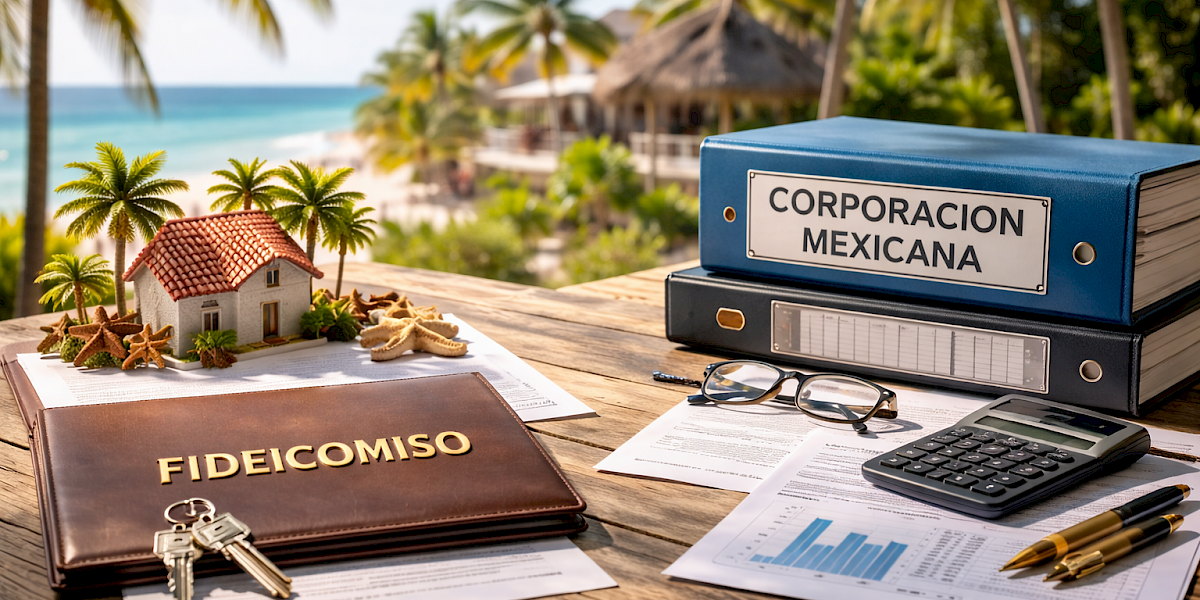
Fideicomiso vs. Mexican Corporation for Coastal Zone Property: When Each Structure Makes Sense
If you’re a foreign buyer purchasing near the coastline, you’ll usually hear one of two options:
Fideicomiso (bank trust)
Mexican corporation (typically an S.A. de C.V. or S. de R.L. de C.V.)
Both can work. The “best” one depends on your priorities: personal use, rental operations, future resale, inheritance planning, compliance tolerance, and how hands-on you want to be.
This guide is meant to help you choose the right structure before you commit—so you don’t end up rebuilding your ownership setup later.
First, what is the restricted zone?
Mexico restricts direct foreign ownership of residential real estate within certain distances of the coast and borders. In practice for Riviera Maya buyers, that typically means you’ll use a fideicomiso for personal residential ownership, or a Mexican company in certain scenarios.
(Your notary will confirm whether the property is in the restricted zone and what structure applies.)
Option 1: Fideicomiso (Bank Trust)
A fideicomiso is a legal arrangement where a Mexican bank acts as trustee and holds title, while you (the beneficiary) retain the rights to use, enjoy, lease, improve, and sell the property.
Best for
Lifestyle + investment buyers (some personal use + rentals)
Buyers who want simpler ongoing compliance
Buyers who want a structure that is widely understood in coastal closings
Buyers who prioritize a clean “one asset” ownership approach
Practical advantages
Often the most straightforward path for foreign individuals
Usually lighter ongoing administration than running a company
Familiar structure for resale (especially in resort markets)
Considerations
There are bank fees (setup and annual) and trust administration
The bank is involved as trustee (administrative step, not day-to-day control)
If you want to run a business with multiple properties and formal operations, a trust may not be the most scalable tool
Option 2: Mexican Corporation (Company Ownership)
A Mexican corporation owns the property and you own shares/quotas in the company. This is sometimes used when the property is clearly tied to a business model (multiple assets, formal operations, partners, etc.).
Best for
Buyers who plan to operate multiple properties under a single structure
Investors with partners or a more complex capitalization plan
Owners who want a “platform” that can expand (staff, contracts, commercial activity, more assets)
Practical advantages
Can be useful for structured operations and scaling
Ownership transfer can be structured via share transfer (depending on the specific case and documents)
Fits certain investor profiles that already operate with corporate governance
Considerations
You’re taking on corporate compliance: bookkeeping/accounting, annual obligations, corporate books, governance steps
If it’s only one condo and you’re not truly operating a business, a company can be “too much structure”
You’ll want tax guidance early to align the company’s activity with your rental plan and reporting needs
How to choose: the decision framework we use
Here’s a practical way to decide, based on real client scenarios.
Choose a Fideicomiso if:
You want to use the property personally (even part-time)
You want simple ownership that is common in coastal transactions
You will rent the property, but your main goal is not to build a multi-asset business
You want fewer moving pieces and lower administrative overhead
Consider a Mexican Corporation if:
You’re building a portfolio (more than one property) or planning to
There will be multiple investors/partners
You need a formal structure for contracts, operations, staff, or growth
You’re comfortable with ongoing corporate compliance and accounting
The common mistake: choosing based on “what someone heard”
Two myths cause problems:
Myth 1: “A corporation is always better for taxes.”
Tax outcomes depend on your facts and compliance. A company is not a magic tax switch—it’s a legal vehicle with responsibilities.
Myth 2: “A fideicomiso means the bank owns my property.”
The bank holds title as trustee, but you retain beneficiary rights to use, lease, improve, and sell—your legal control is real, just structured.
What to ask before you choose (quick checklist)
Before you pick a structure, answer these questions:
Will you use the property personally (even occasionally)?
Is this a one-property purchase or a portfolio plan?
Are there partners or future investors involved?
How important is a clean resale path in the next 3–7 years?
Do you want to keep administration minimal, or are you comfortable with ongoing corporate obligations?
Are you renting casually, or operating with a business mindset (contracts, staff, multiple units)?
If you can answer those clearly, the “right” structure usually becomes obvious.
For many foreign buyers purchasing a single condo or home near the coast, a fideicomiso is the simplest and most common ownership structure.
A Mexican corporation can make sense when the property is part of a broader investment platform—especially if there are partners, multiple assets, or a formal operating plan.
Choosing correctly upfront protects you from future restructuring costs and avoids compliance surprises.

Aarón is a born and raised "chilango". After finishing his university studies, what started as a social service trip became his new home and where he started a family in Playa del Carmen. He enjoys the delicious food and culture of the Yucatan peninsula with his wife, daughter, and son. As a professional, he has made a career as a specialist in social networks and electronic media, helping the companies he has worked for to efficiently achieve all their objectives in the medium.