
Lock-Offs, Flex Spaces, and “2-in-1” Layouts in Playa del Carmen: How Smart Floorplans Multiply ROI
Why layout matters more in Playa than people think
In Playa del Carmen, the difference between an average-performing rental and a consistently strong one is often not the view, the décor, or even the amenities—it’s the floorplan. A “smart” layout gives you options: different guest profiles, different stay lengths, different pricing strategies, and better resilience during slower weeks.
That’s why investors keep gravitating toward lock-offs and flexible layouts—units designed to adapt without feeling improvised.
What is a lock-off (and why it can outperform a standard unit)
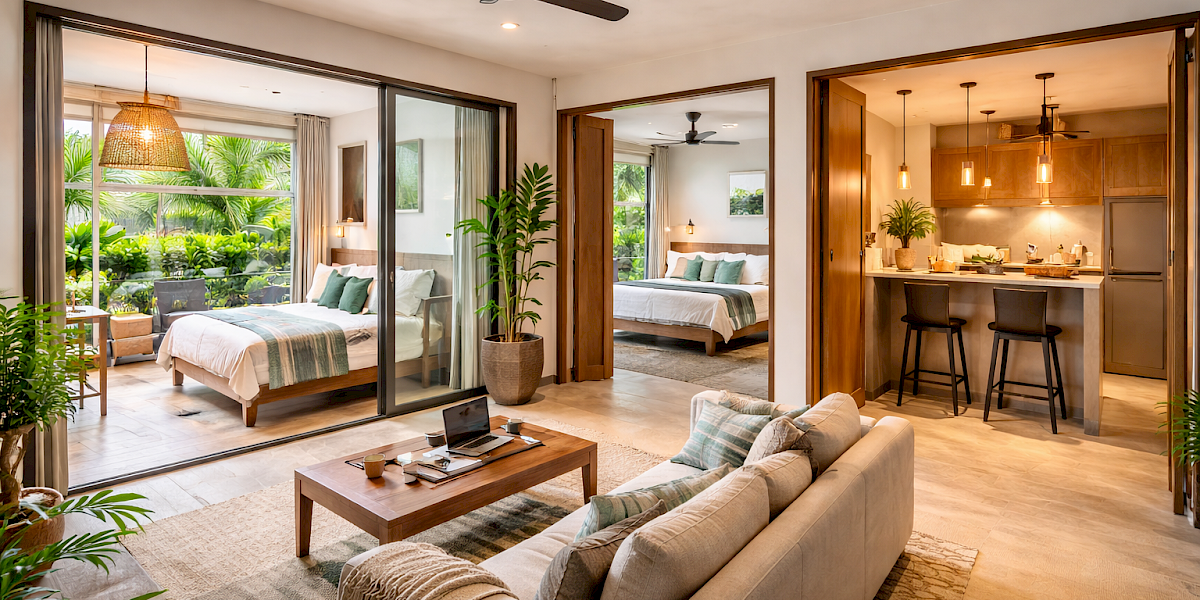
A lock-off is a property configured so it can operate as two independent rentable spaces—typically a main suite plus a separate studio-style section. The best lock-offs have:
Two distinct entrances (or a clear separation that preserves privacy)
Two sleeping zones that feel intentional (not cramped)
Enough functionality for each side (bathroom access, storage, basic living comfort)
When executed correctly, a lock-off can let you capture revenue in more scenarios than a single-layout unit—because you can serve different guest types without forcing “one size fits all.”
Who books lock-offs and flexible layouts in Playa
Flexible layouts are strong because they match real traveler behavior:
Couples who want a well-located studio-style stay
Friends who want privacy but want to travel together
Small families who need separation (kids sleep early; adults still want living space)
Remote workers who prioritize a dedicated work zone and strong internet
Medium-stay renters who want livability, not just a crash pad
A well-designed lock-off can serve two markets at once: short stays (vacation rentals) and medium stays (remote work, seasonal residents), depending on season and demand.
The “2-in-1” advantage: more levers, less risk
Traditional condos rely heavily on one booking pattern. Flexible layouts give you multiple levers:
Rent the full unit during peak periods
Split the unit in shoulder seasons to protect occupancy
Price each side differently based on demand (e.g., studio vs. 1BR)
Keep one side blocked for owner use while the other side still produces revenue (when rules allow)
The outcome is not guaranteed higher income every month—but it often reduces volatility, and that matters if your goal is stable, repeatable performance.
Flex spaces that can work (when done right)
Not every “flex space” is real. A legitimate flexible layout feels natural to the guest and operationally clean. Examples that often work well:
A true lock-off configuration with privacy and access separation
A 2BR with a separable sleeping zone (good doors, good flow, good sound separation)
A den or alcove that works as a real second sleep zone (ventilation, comfort, privacy)
A rooftop terrace that meaningfully improves ADR (not just “nice-to-have”)
The guiding rule: the space should feel designed, not improvised.
The operational side: what investors must confirm
Flexible layouts add upside—but they also add operational details. Before buying, confirm:
HOA/condo rules: rental policies, check-in procedures, guest limits, noise rules
Access & security: how keys/locks work, whether staff supports guest flow
Utilities and comfort: A/C performance, water pressure, sound transfer
Internet stability: essential for medium stays and higher review scores
Housekeeping workflow: can turnovers be done efficiently for each side?
If operations become complicated, the “extra revenue” can be offset by friction, downtime, or guest dissatisfaction.
Red flags: when “flexible” becomes “problematic”
Be cautious when you see:
A “lock-off” that is really just a curtain, a thin divider, or no privacy
Bathrooms positioned so one side can’t function independently
Awkward access that forces guests to cross another guest’s space
Chronic maintenance issues in the building (that can tank reviews)
Layouts that look great on paper but feel tight, dark, or noisy in real life
In Playa del Carmen, guest expectations are high—especially in walkable micro-locations. If the space feels compromised, reviews will tell that story quickly.
What we’ll prioritize for Week 3’s featured listings
To align with this theme, the strongest listing candidates usually include:
True lock-offs or two-zone layouts that maintain privacy
Units that can support both vacation and medium stays (internet, livability, storage)
Buildings with clear rules, consistent management, and smooth guest logistics
Floorplans that are efficient—not just “bigger”
Bottom line
In Playa del Carmen, location draws attention—but layout drives performance. A lock-off or truly flexible unit can give you more booking paths, better resilience across seasons, and stronger appeal to the guest profiles that return year after year. For Week 3, we’ll spotlight properties where the floorplan isn’t just attractive—it’s strategically built to produce.

Aarón is a born and raised "chilango". After finishing his university studies, what started as a social service trip became his new home and where he started a family in Playa del Carmen. He enjoys the delicious food and culture of the Yucatan peninsula with his wife, daughter, and son. As a professional, he has made a career as a specialist in social networks and electronic media, helping the companies he has worked for to efficiently achieve all their objectives in the medium.